

Good business strategy helps you know who you don’t want as customers as well as who is your ideal client. So you’ve decided you don’t have any interest in being a supplier to Walmart. You’re not alone.
Most businesses have other sales channels to sell their products. However not being prepared to do business with Walmart is taking a risk that only you can decide if it is low or high.
Do you know if any of your customers are interested in Walmart’s business? If yes, you may find yourself in what is becoming an “audicious supply chain” related to sustainability and social impact. You may never need to have Walmart in your sales channel but your customer might and now so do you.
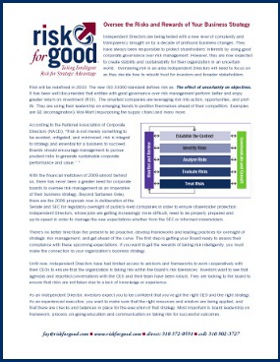
Yesterday, Walmart announced a new tool to assess the quality of their suppliers. If you sell a product you are taking the risk of being left behind if you ignore Walmart’s influence.
What you can do:
Take a deep breath and think about who you need to bring together to help you assess your business risk related to sustainability and social influences. Or not and risk being left behind?
We think of risk as what we are doing but in this case it just might be what you have yet to do! If you are ready to give this some attention I’m here to help you set the table to evaluate opportunities and risk in your business: (310) 372-0591 or fay@123safety.com
Walmart Sustainability Summit 2009:
Products will be evaluated via a Life Cycle Assessment, this traces products from their raw materials through production, transportation, consumption and disposal. This intent of the assessment is to cover not just the environmental impact of a product but also its social impact:
“Measurements of sustainability will be holistic and account for both environmental and social imperatives throughout the entire life cycle of the product including manufacture, distribution, consumer use, and post-use. These measurements will be derived from four areas: energy and climate, material efficiency, natural resources, and people and community.”
I’ve edited SEC Chairman Mary L. Shapiro’s recent speech. Her conclusions have been moved so we can beginning with the end in mind.

Conclusion: Regulatory Reform with an Investor Focus
Though I’ve briefly sketched out this morning my view of how a new regulatory system as a whole should work, I will be candid with you: my heart is with investor protection. Indeed, it is to that cause that I have literally sworn an oath. And so, let me end these remarks with a promise. In the weeks and months ahead, I will do whatever I can to make sure that the interests of investors are preserved in the debate on regulatory reform. Of course, though I am Chairman of the SEC, I am just one person. You must be heard too. I ask you to join me in ensuring that our markets are well regulated and that our investors are left fully protected.
I am certain that bold and innovative regulatory reform can be accomplished in a way that is consistent with the principles I have laid out this morning. I am also convinced that getting it right will require hard work, attention to detail, and an over-riding commitment to furthering the public interest. I know we can do this.
Thank you for listening. I would be pleased to answer any of your questions.
What We Are Doing Now
Understanding that there is no time to waste, the SEC is acting aggressively to transform itself into a stronger, better, and more agile regulator. Our goals are to do more of what we do best and to do all the rest better than ever before.
We have started to revitalize our enforcement program. Led by Rob Khuzami, our new Director of Enforcement, we will revamp the Enforcement Division so that we bring the cases that count, we bring them as quickly as fairness allows, and we achieve results that impress upon wrongdoers the folly of breaking the federal securities laws.
In the last three months, we obtained 27 temporary restraining orders stopping fraudsters in their tracks, compared to seven over the same period last year. I know this group is aware of our action this week regarding the Reserve Fund and its senior officers. In that case, we are acting not only to redress wrongdoing but also to get money to as many investors as possible, as quickly as possible.
We have entered what will be one of the most active rulemaking periods in the Commission’s history. We recently proposed rules to curb abuses in short selling. Next week, we will consider rule proposals for significant enhancements to controls around investment adviser custody of customer assets, to reduce dramatically the possibility that frauds like Madoff might happen again at a registered broker-dealer or investment adviser.
Shortly, we will consider a proposal to enhance investor access to corporate proxies, to make real the promise of universal corporate suffrage, so shareholders can act as the owners the law says they are. We are also working diligently to address problems at the credit rating agencies and recently held a public roundtable to discuss how we can better align the interests of those issuing credit ratings with the investors who use them.
All that is just the beginning. There is so much urgent work to do.
The Future of Financial Regulation
Topping our agenda is regulatory reform. We are lending our voice to the formulation of a structure that will protect our financial system today and for years to come, and will be based on key principles.
These principles are those bequeathed to us by the New Deal reformers who created the SEC 75 years ago, as well as much of the regulatory apparatus that has served us so well for generations. While the time plainly has come to update that apparatus to serve the needs of today and tomorrow, the time will never come to discard the underlying principles.
The Principles
I believe these are the principles that we must follow:
First, any system of regulation must take as its touchstone the protection of individual well-being. At the SEC, as you know, we call it investor protection. Though we are not, as some would have you believe, focused solely or even primarily on retail transactions, and we regulate institutions and markets, our focus has been and must remain on how our actions benefit the workers, savers, and investors of the United States.
We must and do attend to the safety of institutions, particularly those that are significant to our financial system, but as a means to an end and not as an end in itself.
Second, any system of regulation should be designed to facilitate fair and efficient financial markets, not to supplant them. Events of the last year provide a brutal reminder that markets are neither self-regulating nor self-correcting. A strong and steady regulatory hand is needed to assure their continued survival. But that hand must not be so intrusive as to point to winners and losers, lest we lose the benefits of competition.
Our regulatory system must accommodate lively competition for capital. Competition for capital forces our markets to be both innovative and efficient. Competition for capital ensures that money flows to where, over the long run, it does the most economic good. Our new system of regulation must balance the difficult tasks of ensuring the safety of financial institutions while protecting the continued vibrancy and competitiveness of our capital markets.
Despite the economic devastation of the 1930s, the New Deal reformers possessed the wisdom and foresight to recognize that competitive capital markets are essential to allocate risk efficiently and promote economic prosperity. They did not attempt to banish risk from the capital markets; instead, they fashioned a regulatory structure that would channel competitive forces to manage risk efficiently. Stable markets that manage risk and allocate capital effectively are essential for economic prosperity.
Third, any new regulatory system must promote and preserve public trust in our financial markets. Markets do not work well unless investors believe they do. And investors will not believe that markets work well unless they do, in fact. That means, above all, that investors must know that the information upon which they base their investment decisions is the truth, the whole truth, and nothing but the truth.
Some may believe that there may well be extraordinary circumstances in which the truth is withheld from the markets when the very survival of indispensable financial institutions is at stake. But make no mistake, when the truth is withheld, we all pay a very high price. Without that essential confidence that they have truthful and complete information upon which to base their decisions, investors will avoid our financial markets for ones that are more transparent, or they will demand risk premiums for their continued participation.
The efficient allocation of capital is simply impossible without transparency. To state the obvious, markets rely on words and numbers. They must both be true; and any new regulatory structure must preserve the integrity and independence of those charged with the responsibility for setting standards of financial disclosure.
Investors also need to be confident that when they transact in markets the architecture will work. Amidst all the economic devastation, it is understandable that we forget that over the last year, despite record volumes and enormous volatility, our markets have priced, processed, and cleared hundreds of billions of dollars in customer orders in an orderly and generally fair way.
The New York Stock Exchange, for example, had an average daily trading volume of approximately 4.1 billion shares in the fourth quarter of 2008. These trades were processed efficiently and effectively.
Finally, when investors transact through intermediaries, they must be able to trust that those intermediaries deal with them honestly and fairly and with investors’ well-being as their sole goal.
The Architecture of the New System
We can have a system of financial regulation that accommodates these principles. That system should include —
- An entity responsible for the regulation of the markets for investment capital
- An entity (or entities) responsible for regulating banking institutions
- An entity responsible for monitoring and averting risks to the financial system as a whole, and…
- An entity responsible for resolution of troubled institutions.
Let me elaborate briefly.
Systemic Risk Regulator and Resolution Regime
Finally, there needs to be a government entity whose responsibilities include the monitoring of our financial system for system-wide risk, with the tools to forestall emergencies. Moreover, we need to improve our capacity to wind up financial institutions that are no longer able to function. I believe there is substantial consensus about the need for these regulatory functions.
There is, though, rather less consensus about the precise form such a regulator should take — whether a single entity, a College of Regulators approach, or a hybrid as FDIC Chairman Sheila Bair proposed this week: a single regulator for systemically significant firms coupled with a systemic risk council to provide macro-prudential oversight of risk. Regardless of the form, it should have access, largely through the functional regulators, to sufficient information to provide a view of the financial system as a whole. And it should have sufficient power to direct prudential regulators to strengthen capital requirements and to direct institutions they regulate to reduce leverage as circumstances require. That said, there are many important issues around the definition of authority for such a regulator.
I’m inclined towards the structure envisioned by Chairman Bair. Given the various components of effective financial regulation, I have long been concerned about excessive concentration of power — which really means excessive concentration of point of view — in a single regulator.
But at the end of the day, what will most ensure the success of a new regulatory structure is the clear commitment to vigorous regulation and oversight of our financial markets and institutions.

So why are we smiling? My story is that our smiles come as a result of professional risk taking. Tim Sanders was the keynote speaker at the 2009 ASSE Professional Development Conference in San Antonio.
How did I get to share time with Tim during his busy morning? The answer is I raised my risk tolerance to pursue connecting with him. Why would I move from a virtual connection to a person to person connection? I connect with Tim’s message on Corporate Responsibility. The world of social media - twitter, facebook and linked in gives me a way to invest my time with people who share my values.
I believe that values will be a way to connect in the age of transparency. Yes education, social class, professional affiliations, geography all count but the power of social media is opening new opportunities. So back to risk taking.
I was on a panel speaking about CSR and the safety professional at the conference. Professionals with Safety, Health and Environmental expertise are in my opinion at the right place, at the right time with the right expertise. Corporate Social Responsibility is built on understanding the value proposition that safe & healthy people are the new talent we need to support to engage in solving environmental challenges.
Tim’s message is clear - take professional risk in moving CSR forward in your organizations. The world need you!
It only made sense to me that our keynote would want to support our session. Turned out I was right. So when you think you align with values with your twitter virtual connection I encourage you to make it real. That is why we’re smiling.
Here is the outline for the presentation Tim made in San Antonio. It was great. Now I’m reading his book, Saving the World at Work. Please join us by taking the risk - you too will smile when you raise your tolerance by aligning your values with your virtual friends. It’s all good!
Fay can be followed on twitter at: @fayfeeney
Tim can be followed on twitter at: @sanderssays
Saving The World At Work
What you can do to help your company go beyond making a profit to making a difference.
“There is a revolution going on the business world where companies will compete based on social innovations. Consumers, talent and investors are gravitating to companies that achieve high levels of social responsibility towards people, communities and the environment. The key for companies to thrive during this new era of business is to innovate how it does business and achieve high levels of employee participation.
Tim’s keynote has an empowering message: A single employee or small group of people can help lead his or her company to success during this new revolution. Stories include: A regional sales manager at Interface Floor that saved landfills from over one hundred million tons of discarded carpet. A corporate attorney that convinced Microsoft product managers to dramatically reduce packaging size and waste. A small group of bank tellers that convinced their senior management to get involved in breast cancer fundraising as a branding strategy.
This talk will challenge audience members to: Improve the quality of life of all employees and workers. Participate in current corporate or association community projects. Reduce individual and company environmental footprint. This talk is perfect for meeting planners looking for: Sales motivation/incentive, Leadership, Branding, Business Trends, Green Business and Social Responsibility.”

Corporate directors could find themselves exposed to liability if they fail to keep pace with evolving best practices in enterprise risk management (ERM), according to a major new study released today by The Conference Board in conjunction with McKinsey & Company and KPMG’s Audit Committee Institute.
Since ERM processes have improved in some companies, many corporate directors could be functioning with a false sense of security, the study points out. New legal requirements are steadily suggesting that directors should ensure that their companies have a “robust” ERM program.
The report, authored by Carolyn Kay Brancato, Matteo Tonello, and Ellen Hexter of The Conference Board, is entitled The Role of the U.S. Corporate Board of Directors in Enterprise Risk Management.
These findings are based on a comprehensive research effort on the topic that incorporated personal interviews with 30 board members, analysis of Fortune 100 board committee charters, and a broad survey of 127 board members. The report has not yet been released, but is forthcoming.
Dr. Brancato, Director of The Conference Board Governance Center and Directors’ Institute, said today: “Our research shows many directors believe they have a good handle on the risks their companies face. But since many directors tend to approach risk more on a case-by-case basis, they may not have adequately robust and systematic enterprise risk management processes in place.”
The study shows that banking and financial services tend to have more developed ERM processes and may therefore set the standard by which other industries will be measured.
Chief Risk Officers Gaining Clout
In addition to the CEO, the corporate executive most frequently cited by directors as responsible for informing the board on risk issues is the CFO (71% of companies). However, at a growing number of companies, a Chief Risk Officer is cited as the person informing the board and appears to be an increasingly visible company executive (for instance, in 16.1% of financial companies, up from virtually none a few years ago).
False Sense of Security?
Dr. Gunnar Pritsch, a partner of McKinsey & Company, who collaborated with The Conference Board on the study, said: “Things have definitely improved since we did a similar survey in 2002.”
Data in 2002 showed that 36% of directors did not believe that they had a full understanding of the major risks facing their companies. By 2006, that percentage decreased to 10.5%. However, he also said that “Boards still have a way to go. Directors serving on multiple boards reported significant variations in the quality of the risk dialogue and fewer boards seem to have well established risk processes.”
Dr. Brancato reports: “There may indeed be a false sense of security among those directors reporting that they have a full understanding of the company’s risks. When we asked directors personally, many said they approach risk on a case-by-case basis in connection with a specific strategic issue such as a merger or acquisition or the entrance into a new market. This may not constitute a sufficiently robust process to satisfy directors’ fiduciary responsibilities.”
The new research found significant differences in how directors understand risk and how their companies manage risk. Moreover, directors may have more of a top down understanding of risk.
The Conference Board study finds: Although 89.5% of directors say they fully understand the risk implications of the current strategy,
- Only 77.4% of directors say they fully understand the risk/return tradeoffs underlying the current strategy.
- Only 73.4% of directors say their companies fully manage risk.
- Only 59.3% of directors fully understand how business segments interact in the company’s overall risk portfolio.
- Only 54.0% have clearly defined risk tolerance levels.
- Only 47.6% of boards rank key risks.
- Only 42% have formal practices and policies in place to address reputational risk.
Directors are, however, sensitive to the need for additional information:
- While 71.8% of directors believe they have the right risk metrics and methodologies in making strategic decisions, 47.6% of directors would like to see more data analysis related to the company’s risk profile.
Banks and Insurance Companies Out in Front on ERM
Directors interviewed note significant variations in ERM capabilities among companies on whose boards they sit. Some 72.6 % of directors serving on multiple boards see significant variations across firms in terms of their ERM capabilities. Directors in financial companies tend to report more robust ERM practices.
For example, 64% of financial company directors report their companies have clearly defined risk tolerance levels versus 47% of the nonfinancial company directors (compared with 54% for all directors).
Financial service company directors also report a higher level of routine consideration of all major risks compared to considering risks only when management brings them to the board. Two major findings:
- 55% of financial directors report the board considers all major risks including strategic risks versus only 25% of nonfinancial directors (compared with an average of 39% for all directors).
- 27% of financial directors report they consider risks primarily when management brings them to the board, versus 50% of nonfinancial directors (compared with an average of 39% for all directors).
The Conference Board study suggests that standards used in the banking and insurance industries may set the pace for all companies.
This factor may be increasingly important to directors in determining their exposure to liability for failing to meet their fiduciary duties - as the courts may increasingly look to comparative “best practice” standards by which to measure directors’ performance of fiduciary duties of care, loyalty and good faith.
Beyond Audit Committees
The board committee charter analysis of the Fortune 100 companies indicated that about two-thirds of corporate boards place board risk responsibility in the audit committee. Caryn P. Bocchino of KPMG’s Audit Committee Institute, who also worked with The Conference Board on the study, discussed the organizational aspects of board oversight of risk management.
She noted: “Although it’s clear that the audit committee is the most common place for risk management oversight responsibility, audit committees are already heavily involved with their basic financial reporting risk responsibilities. Boards may consider assigning the non-financial reporting aspects of risk management oversight to another committee in coordination with the audit committee.”
Dr. Brancato also noted that giving the more operational aspects of ERM to another committee might be beneficial; then the audit committee and this other risk-related committee would report to the full board. In fact, the study finds that, in addition to the 66% of companies where the audit committee is the sole repository of risk oversight, in 23% of companies another committee shares this responsibility with the audit committee.
A few, mostly financial, institutions have established separate Risk Committees with an integrated view on all risks the company faces (of the companies surveyed, 16% in the financial services area report having a separate and distinct risk committee for more than 2 years, versus less than 4% in the nonfinancial area).
Source: The Role of the U.S. Corporate Board of Directors in Enterprise Risk Management, Report # 1390, The Conference Board
Posted: June 22nd, 2009
at 1:53am by Fay Feeney
Tagged with "decision tree risk analysis", best practices, corporate board, corporate governance, Enterprise Risk Management, ERM, liability, risk, risk assessment, risk management, risk management plan, risk online
Categories: Uncategorized
Comments: No comments

My condolences go to the family of Peter L. Bernstein who passed away at age 90. He was not only a brilliant thinker on risk but someone who loved the historical view of risk. His video is well worth the time to hear what Peter, in his 90 years of experience, knew for sure.
His central theme is that risk doesn’t mean danger—it just means not knowing what the future holds. That insight resides at the core of risk management for companies, whether in managing the potential downside of an investment or putting a value on the option of waiting when making irreversible decisions.
Even at 90 years old he understood that experience does not give you the power to know what the future holds. This give you as an executive a challenge to prepare knowing that the outcome might be different from what you expected. If it is any comfort all analytic approaches lack certainty that you’ll have the right answer.
He makes it clear that the best expectation of risk management is that a systematic approach will reward you with a set of scenarios and the opportunity to think through possible outcomes. If they happen only then will you know if you were right or wrong based on the assigned consequences. Maybe not as much fun as growing sales but important work.
If you want to help your business see risk in its relation to return your timing is good. How you identify and deal with risk is a sign of business and executive maturity. Peter makes it clear that although you may have a risk with a small probability the event can happen at any moment. Your team will be judged on how well you deal with it.
Leading a successful business in these uncertain times is challenging. Having risk management helps you decide if a decision is irreversible in the face of uncertainty. I’m confident that Peter would agree that this is a good risk management framework. Peter L. Bernstein knew this for sure, R.I.P.
http://www.mckinseyquarterly.com/Peter_L_Bernstein_on_risk_2211


This Friday I celebrated my mentoring success story by having lunch with Tony Sclavenitis. Tony is a safety specialist at the UCLA Medical Center. His job has impact for preventing injuries, illness and accidents for all hospital employees, patients and visitors. Tony is assigned fire drills, hazardous material, ergonomics and helps the other safety team members.
If you are a patient at the UCLA Medical Center you want a guy like Tony on the job.
Tony was my client at Comcast Entertainment and is an enthusiastic student for safety, health and environmental knowledge. He recently made the move from entertainment (production safety) to hospital operations.
My professional and personal lives were aligned yesterday as I walked through the doors of the Stewart and Lynda Resnick Neuropsychiatric Hospital at UCLA. I’m a fan of Lynda and her wisdom on marketing. I follow her at @lyndaresnick on twitter.
20 years earlier I had walked through those doors as a family member in distress. One of my passions is fighting stigma and being an activist for people with mental illness. So as I walk in the door with Tony headed to lunch in the cafeteria I’m thinking about:
- My gratitude for the hospital and their expertise in giving me back a family member who was lost to mental illness
- The good that comes from the generosity of donors like Stewart and Lynda Resnick
- The new opportunity Tony gives me as he stewards my love of our profession
TGIF when you can help someone like Tony make professional progress and gain the satisfaction of having your mentoring “paying forward” to a place that saved the life of a loved one. That’s a wrap.
I finished my three days with the UCLA Anderson Directors Education and Certification program. What a amazing experience. My interest in corporate governance has been growing stronger over the years. My first thoughts were when I was working at The Travelers Insurance Company. I remember waiting for the annual report to land on my desk. As an employee their stock was my first experience owning equities. So I’d get the annual report and first look for people I knew or had met in passing. Second I’d turn to the page of directors and wonder how they got invited to serve. This question continues to spike my interest to this day. How did they get selected to be the overseers or more politely the people to govern. I’ve formulated some opinions over the years and look forward to sharing them with you at a future date.
I just got in after day one of the UCLA Anderson School Directors Education and Certification Program. The class is a learning opportunity for corporate directors to get their skills sharpened. I was honored to coordinate a session on Enterprise Risk Management. The session was a success with director interest in managing risk at an all time high.
After the financial meltdown it is time for business to get the reward back into the risk thinking of management. This is a subject that requires some enthusiasm to get people to think about risk in a positive way. We heard from legal experts that risk management will be on the agenda for both the SEC and proposed legislation.
This is a subject that aligns and supports business strategy. Directors have reason to ensure that the management of their companies think about risk. Business will need to get good at risk thinking to survive and thrive in the coming days. Back to school tomorrow.
UCLA Executive Education is highly recommended for keeping your career skills sharp. Lots of smart people in the room.